Meta's Muse Wonder is here: Meta's first frontier model, but no open weights
Meta Superintelligence Labs has released Muse Wonder and Muse Wonder Full, agent-focused models that land near the top of the Artificial Analysis index. Wonder costs $4 / $20 per million tokens through the API. Wonder Full is only available through Muse Code. Here are the benchmarks, the pricing and the catches.
On this page
Meta released Muse Wonder and Muse Wonder Full on October 12, 2026. They are the first models from Meta Superintelligence Labs that compete at the frontier, built on the Muse Spark models Meta has shipped since April. Meta calls them its most capable models to date and says they're built for personal and professional agents. That means long tasks, memory across conversations, computer use and coding. On the independent Artificial Analysis Intelligence Index, Wonder Full scores 56, two points behind the leader, Claude Opus 5.5.
What Meta launched
Meta describes the Muse Wonder series as "frontier coding, long-running agents and advanced computer use". It says the models can plan long tasks, hand parts of the work to sub-agents, call tools in parallel and recover from errors. Meta highlights two features:
- Active Memory: the model carries important context about you across conversations and pulls back the details that matter for the current task.
- Active Focus: the model keeps working on a hard goal, tries other approaches when it gets stuck, asks for clarification when needed and checks in before taking important actions.
Meta says both models were trained at its gigawatt-scale Prometheus data center. It also says they build on "larger, stronger base models" than Muse Spark, which helps them handle unfamiliar tasks better.
| Muse Wonder | Muse Wonder Full | |
|---|---|---|
| Model ID | muse-wonder-1.0 | muse-wonder-full-1.0 |
| Where | Meta Model API, Muse Code, OpenRouter | Muse Code only |
| Context window | 1M tokens | 1M tokens |
| Input / cached input / output (per M tokens) | $4.00 / $0.20 / $20.00 | No API pricing |
| Subscription | Not needed | Muse Code Power Usage ($50/mo) or Maximum Usage ($200/mo) |
Meta also says Muse Wonder will "soon" power its consumer Muse agent app, rolling out to paying subscribers first.
The official benchmarks
All the charts below come from Meta's research blog post. Every model in Meta's comparison was run at its highest effort setting ("max"). The one exception is Wonder Full on SWE-Marathon, which ran at "xhigh".
Artificial Analysis Intelligence Index
This is the independent number, and the most useful one for comparing models. Meta's chart shows how fast it has climbed: from 31 for the first Muse Spark to 56 for Wonder Full, in about six months.
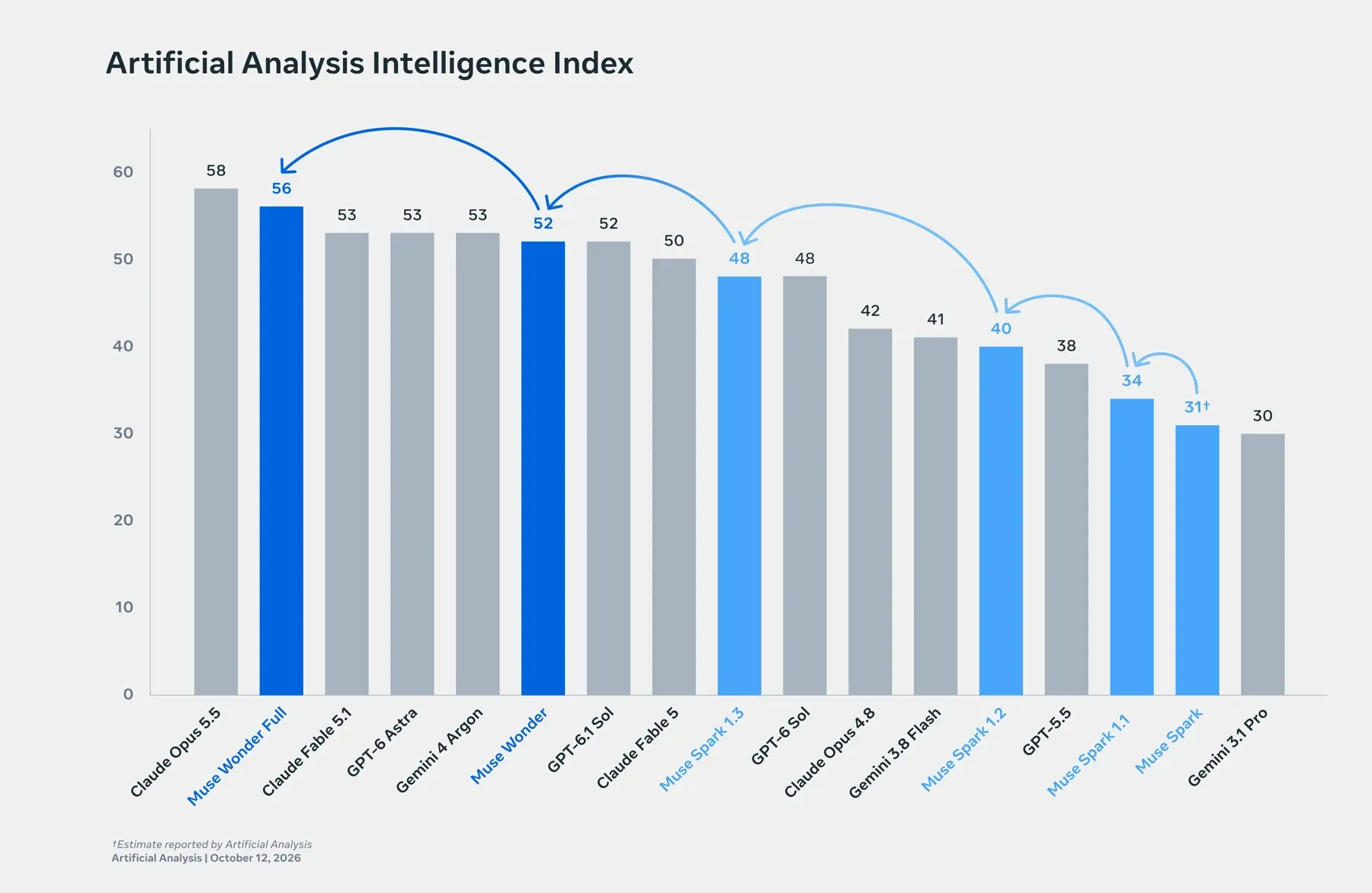
Source: Meta, using Artificial Analysis data as of October 12, 2026.
Full results table
Meta compares both models with Claude Fable 5.1, GPT-6 Astra and Claude Opus 5.5 on 14 tests.
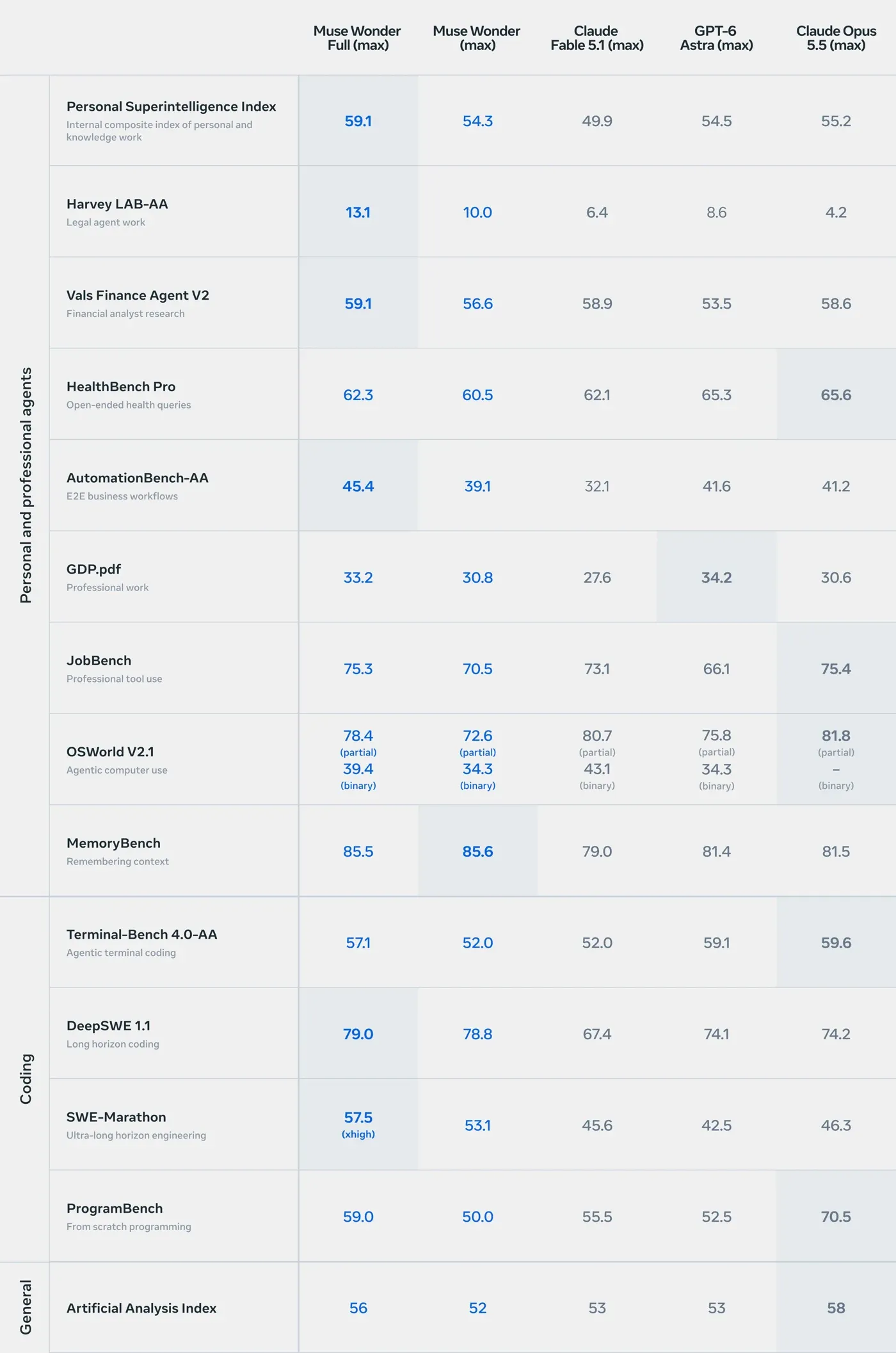
Source: Meta.
Here are the same numbers as text, with the best score in each row in bold:
| Benchmark | Wonder Full | Wonder | Fable 5.1 | GPT-6 Astra | Opus 5.5 |
|---|---|---|---|---|---|
| Personal Superintelligence Index (Meta internal) | 59.1 | 54.3 | 49.9 | 54.5 | 55.2 |
| Harvey LAB-AA (legal agent work) | 13.1 | 10.0 | 6.4 | 8.6 | 4.2 |
| Vals Finance Agent V2 | 59.1 | 56.6 | 58.9 | 53.5 | 58.6 |
| HealthBench Pro | 62.3 | 60.5 | 62.1 | 65.3 | 65.6 |
| AutomationBench-AA (business workflows) | 45.4 | 39.1 | 32.1 | 41.6 | 41.2 |
| GDP.pdf (professional work) | 33.2 | 30.8 | 27.6 | 34.2 | 30.6 |
| JobBench (professional tool use) | 75.3 | 70.5 | 73.1 | 66.1 | 75.4 |
| OSWorld V2.1, partial credit (computer use) | 78.4 | 72.6 | 80.7 | 75.8 | 81.8 |
| MemoryBench (Meta internal) | 85.5 | 85.6 | 79.0 | 81.4 | 81.5 |
| Terminal-Bench 4.0-AA | 57.1 | 52.0 | 52.0 | 59.1 | 59.6 |
| DeepSWE 1.1 (long-horizon coding) | 79.0 | 78.8 | 67.4 | 74.1 | 74.2 |
| SWE-Marathon (ultra-long engineering) | 57.5 | 53.1 | 45.6 | 42.5 | 46.3 |
| ProgramBench (from-scratch programming) | 59.0 | 50.0 | 55.5 | 52.5 | 70.5 |
| Artificial Analysis Index | 56 | 52 | 53 | 53 | 58 |
On this table, Wonder Full has the best score on 6 of the 14 rows, and the standard Wonder model has one more (MemoryBench). Opus 5.5 leads on six rows, including the Artificial Analysis index. So the honest read is "close to the frontier, ahead in some areas". It isn't the new overall leader.
Coding: long-running work is the strength
Meta's coding pitch is about long tasks. On SWE-Marathon, which tests very long engineering projects, Wonder Full scores 57.5% against 46.3% for Opus 5.5. Even the cheaper Wonder beats every non-Meta model.
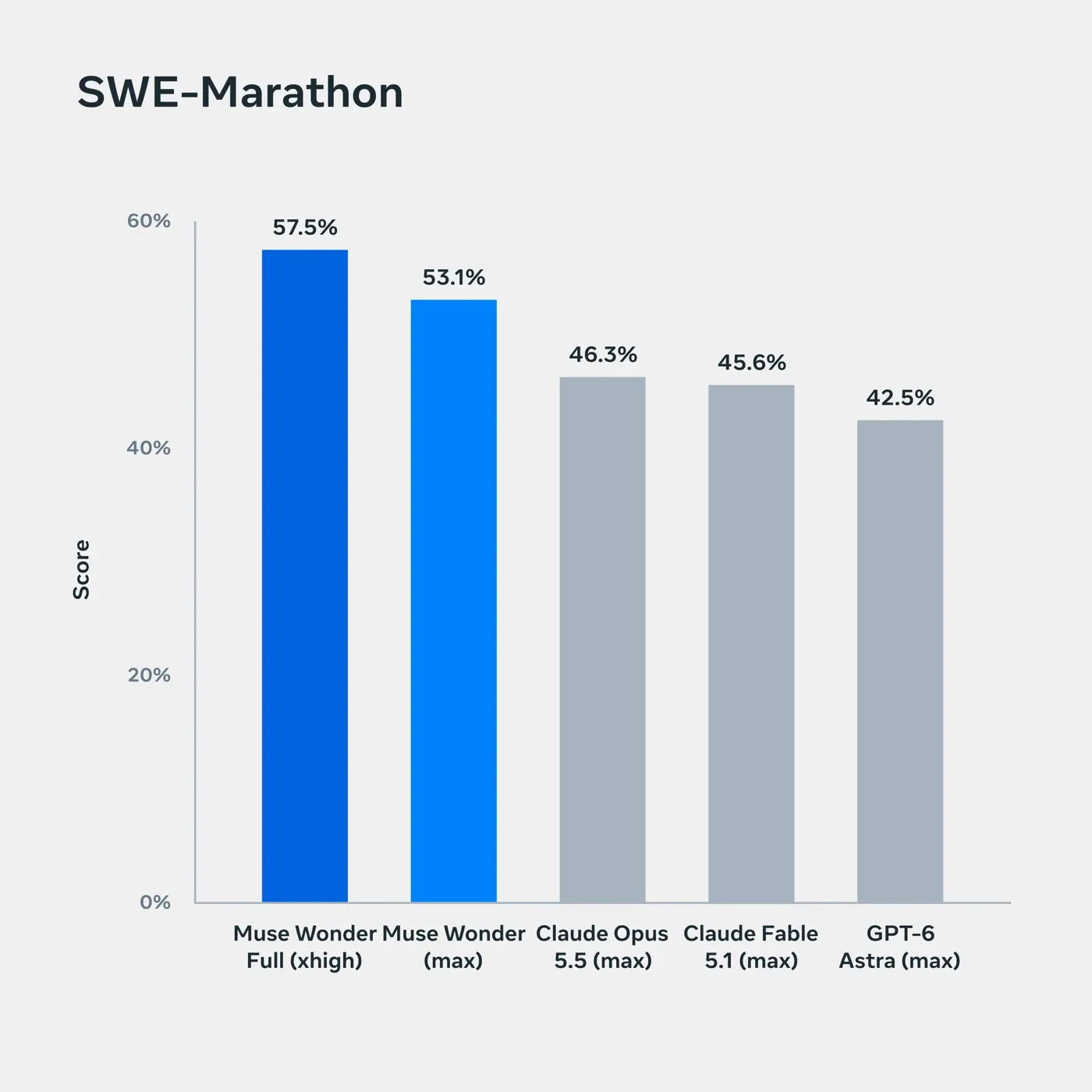
Source: Meta.
DeepSWE tells the same story, with Wonder Full at 79.0% and Wonder close behind at 78.8%.
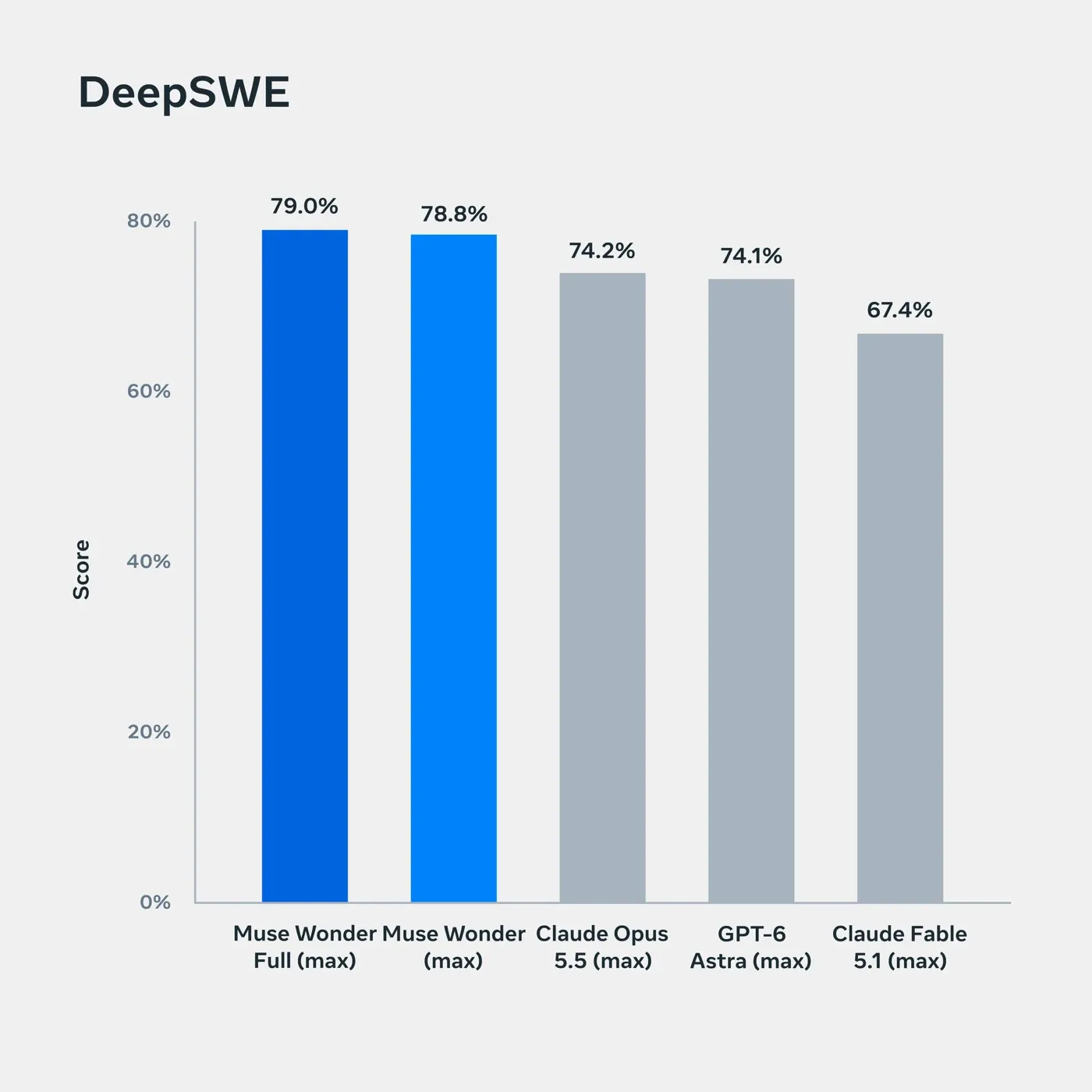
Source: Meta.
Shorter, from-scratch and terminal tasks are a different picture: Opus 5.5 leads clearly on ProgramBench (70.5 vs 59.0) and narrowly on Terminal-Bench 4.0 (59.6 vs 57.1).
Professional agents and memory
The widest gap is in legal work. On Harvey's Legal Agent Benchmark, Wonder Full scores 13.1% against 4.2% for Opus 5.5. The absolute scores are low for every model, which shows how hard real legal tasks still are.
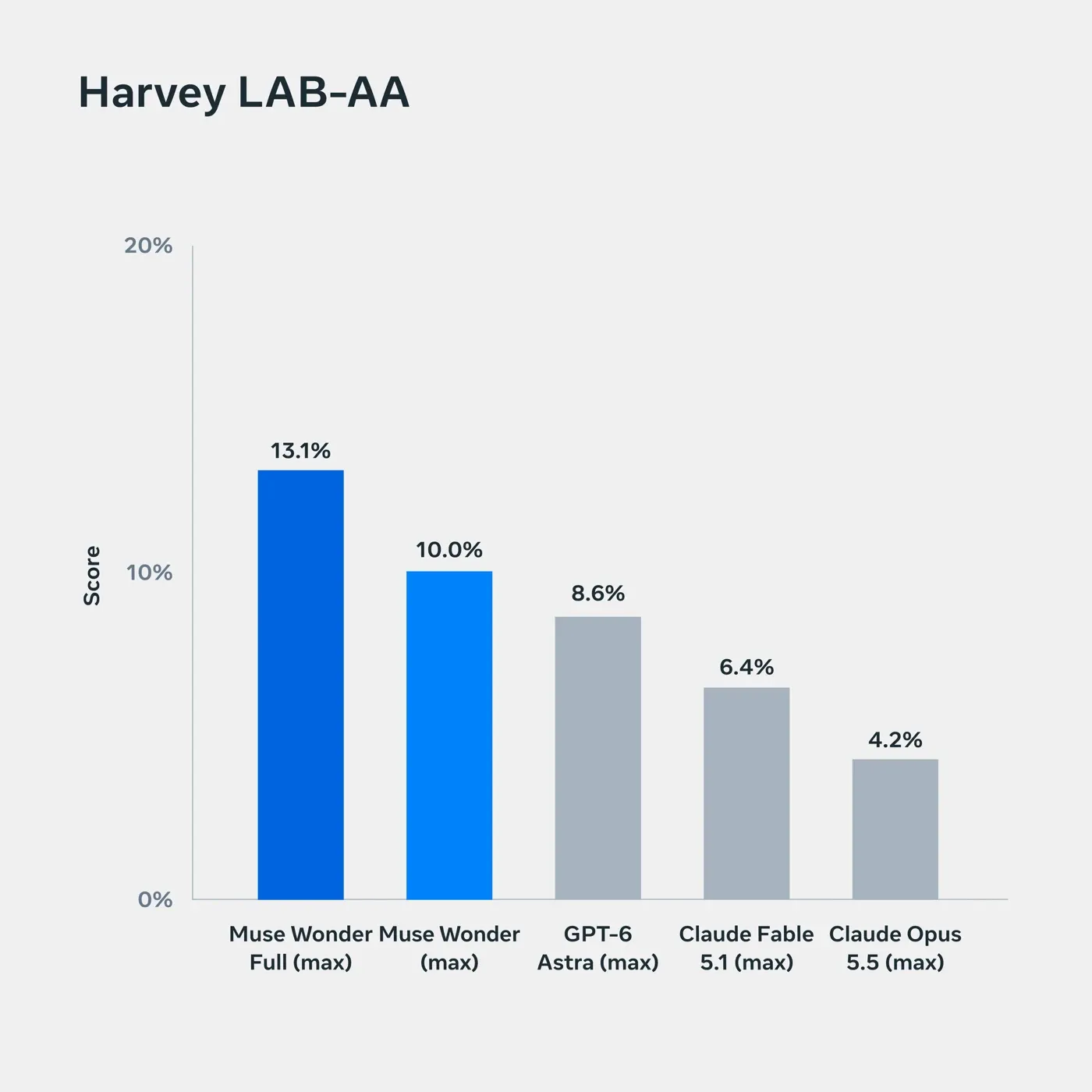
Source: Meta.
On memory, both Muse models score about 85.5% on MemoryBench, ahead of Opus 5.5 and GPT-6 Astra (both about 81.5%).
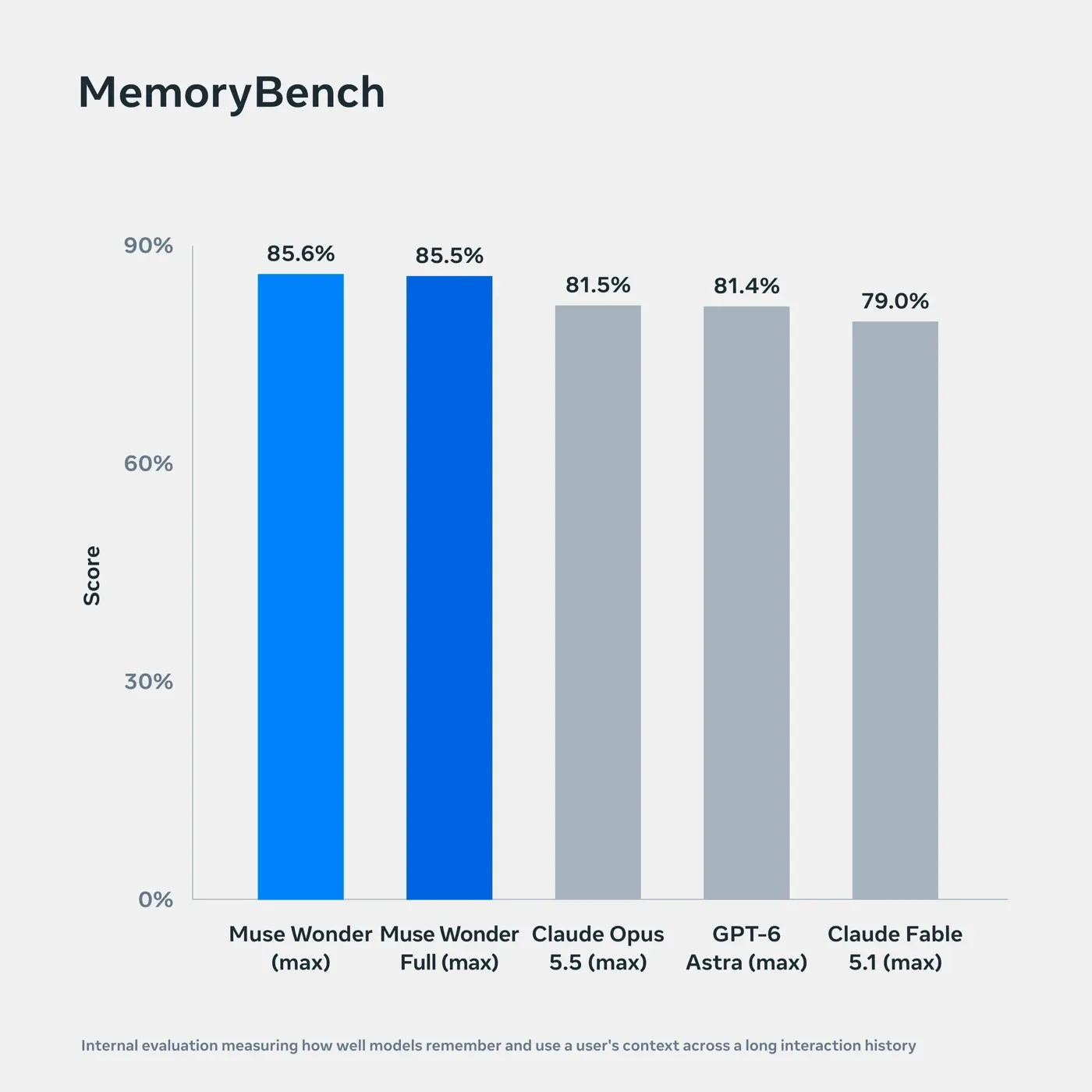
Source: Meta. MemoryBench is an internal Meta evaluation.
The catches
No open weights. Meta built its AI reputation on openly downloadable Llama models, but neither Wonder model can be downloaded. Meta's only open-licensed Muse model is the much smaller Muse Glimmer (Apache 2.0). If you wanted a frontier model you can run yourself, look at the open models from Mistral, DeepSeek, Kimi or GLM instead. Our Mistral Large 4 preview post covers one that is coming soon.
The best model is behind a subscription. Wonder Full has no pay-as-you-go API price. You can only use it inside Muse Code, Meta's terminal coding tool, on the $50 or $200 monthly plans. You can't build Wonder Full into your own product today.
Check the data settings. VentureBeat reports that API traffic runs in a "Standard" mode that Meta says it doesn't use for training. Muse Code subscriptions default to a "Contributor" mode, which may use what you submit to train models. You can switch it off, but the change only applies to future submissions. Do this before you point it at private code.
Pricing isn't cheap. At $4 / $20 per million tokens, Muse Wonder costs more than many rival models, so do the maths before you switch a high-volume workload.
How builders can use it
- Long-running coding agents: if your agents work for hours on big codebases, SWE-Marathon is the most relevant benchmark here, and Wonder leads it. Test Wonder through the API, or Wonder Full in Muse Code, on a real multi-hour task.
- Legal, finance and business workflows: the leads on Harvey LAB, Vals Finance Agent and AutomationBench suggest Wonder is worth a test for document-heavy agent work like contracts, claims and financial research.
- Easy to try: Meta says the Model API works with existing OpenAI-SDK-compatible clients, and Wonder is also on OpenRouter. In many tools, trying it means changing the base URL and the model ID.
- Keep a fallback: for computer use, short coding tasks and health questions, Opus 5.5 and GPT-6 Astra still score higher in Meta's own table.
Bottom line
Muse Wonder is the moment Meta catches up. Six months after Muse Spark, Meta has a model near the very top of the independent leaderboard, with real leads on long coding tasks and professional agent work. But it's a closed, paid model, and the strongest version only runs inside Meta's own coding tool. If you build agents, try Muse Wonder through the API or OpenRouter on your hardest long-running task and compare it with what you use now. Before you send it private data, check the data-use settings, and wait for independent benchmarks before you switch for good.
Sources
Written by
HelloAITech Team · Editor
We cover the latest announcements and features in AI, with a special focus on Claude and Anthropic, and write practical guides to help you put them to work.