Google's Gemini 4 Carbon tops the AI leaderboard, but you can't use it yet
Google's new Gemini 4 Carbon scores 59 on the Artificial Analysis index, one point ahead of Claude Opus 5.5, and leads on cybersecurity tests. For now it is only open to vetted cyber defenders. Here are the benchmarks, the pricing and what builders should do in the meantime.
On this page
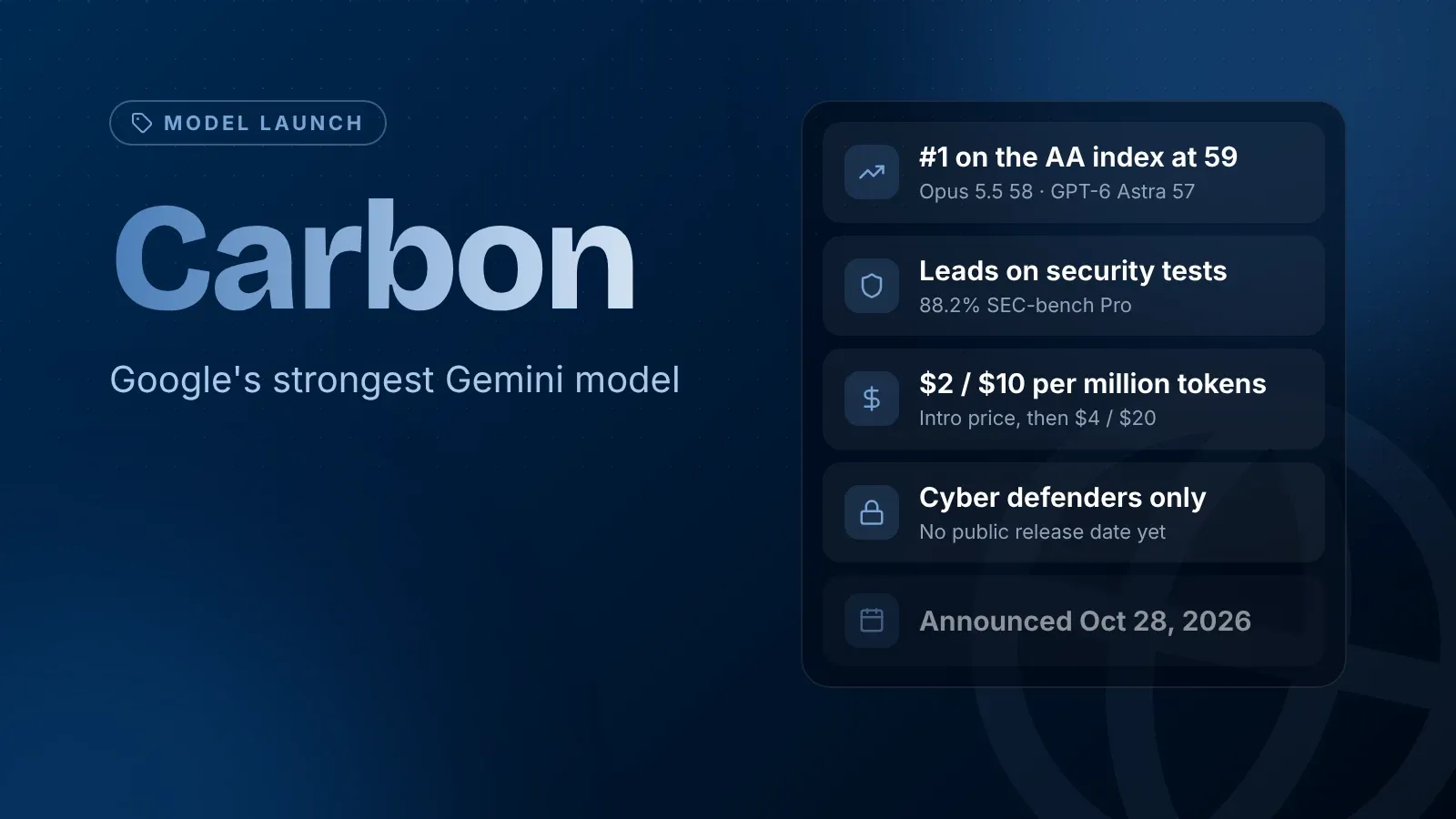
Google announced Gemini 4 Carbon on October 28, 2026, just two weeks after it launched Gemini 4 Argon. Google calls Carbon its strongest model so far, "with state-of-the-art cybersecurity and long horizon capabilities". It now ranks first on the Artificial Analysis Intelligence Index with a score of 59, one point ahead of Claude Opus 5.5. There is a big catch, though: Carbon is not in the Gemini API, AI Studio or the Gemini app yet. For now, only a small group of vetted cyber defenders can use it.
What Google announced
Carbon builds on Gemini 4 Argon, which Google released on October 13. The announcement came from Koray Kavukcuoglu, Google's chief AI architect. In Alphabet's Q3 earnings call the same week, Sundar Pichai said Carbon "outperforms Argon across almost every domain".
Google is pitching Carbon at two kinds of work:
- Cybersecurity: finding vulnerabilities, proving they can be exploited and writing patches. Google says Carbon succeeds at generating secure code more than twice as often as Argon on its internal tests. Google also says its Chrome team found Carbon more than 10 times better at writing high-quality patches than "another lab's large frontier model", which it didn't name.
- Long-horizon tasks: coding and agent jobs that run for hours, not minutes. Some of Google's exploit tests give the model up to 10 hours per task.
This launch also shows how fast the cycle is now. Google shipped two frontier models in 15 days, and Carbon arrives weeks after Claude Opus 5.5 and Meta's Muse Wonder.
Benchmarks
Google published one table comparing Carbon with Argon, OpenAI's GPT-6 Astra, Claude Opus 5.5 and Claude Fable 5.1. Bold marks the best score in each row.
| Benchmark | Gemini 4 Carbon | Gemini 4 Argon | GPT-6 Astra | Claude Opus 5.5 | Claude Fable 5.1 |
|---|---|---|---|---|---|
| Artificial Analysis Index v5.0 | 59 | 50 | 57 | 58 | 49 |
| Vals Index v2.2 | 70.4% | 69.2% | 65.0% | 70.2% | — |
| SWE-sweep (agentic coding) | 9.6% | 4.3% | 9.5% | 3.6% | 2.9% |
| FrontierSWE 2 (agentic coding) | 61.2% | 55.0% | 65.5% | 62.3% | 56.3% |
| Terminal-Bench 4.0 (AA) | 65.2% | 57.1% | 59.1% | 59.6% | 52.0% |
| Agents' Last Exam v1.1 (computer use) | 77.4% | 69.0% | 73.1% | 71.6% | — |
| OSWorld-2.1 (computer use, offline subset) | 81.5% | 74.7% | 80.9% | 87.2% | 76.8% |
| AutomationBench (Zapier) | 53.9% | 51.3% | 41.4% | 42.5% | 31.4% |
| Vending-Bench 2 (bank balance) | $16,484 | $13,718 | $15,515 | $9,235 | $5,422 |
| Chartography (charts) | 72.5% | 71.6% | 71.0% | 66.3% | 46.2% |
| Blueprint-Bench 2 (similarity) | 58.6% | 54.4% | 49.7% | 51.2% | 41.9% |
| GraphWalks (256K to 1M tokens) | 96.2% | 84.2% | 71.8% | 66.8% | 65.0% |
| RiemannBench (math) | 80.0% | 76.0% | 72.0% | 69.6% | 65.6% |
| Terminal-Bench-Science 0.1 (AA) | 64.8% | 52.9% | 63.3% | 59.0% | 43.3% |
| CWE-bench (patching) | 71.0% | 68.0% | 68.0% | 67.0% | 58.0% |
| ExploitGym (exploitation) | 54.8% | 42.0% | 42.4% | 34.5% | — |
| SEC-bench Pro (vulnerability finding) | 88.2% | 83.4% | 85.4% | — | — |
Carbon leads on 15 of the 17 rows. It loses on two that many developers care about. On FrontierSWE 2, GPT-6 Astra (65.5%) and Opus 5.5 (62.3%) both beat it. On OSWorld-2.1, Opus 5.5 is well ahead, at 87.2% against Carbon's 81.5%.
The biggest gaps are in long context and security. On GraphWalks, which tests reasoning across 256K to 1M tokens, Carbon scores 96.2%, while Opus 5.5 gets 66.8%. On ExploitGym, it scores 54.8%, while Opus 5.5 gets 34.5%.
What independent testers say
The two headline indexes are run by outside groups, so you can check them:
- Artificial Analysis lists Carbon first of 57 models at 59. It also notes that Carbon is wordy. It used about 200 million output tokens to finish the index, against a median of 71 million, so real bills can be higher than the per-token price suggests. It measured output at about 83 tokens per second.
- Vals AI gives Carbon 70.36% on its index. Its own page currently lists Carbon second, so the ranking depends on which index and which day you look.
Both list a 1 million token context window. Google's announcement doesn't state one. Argon has a 1M token input-output limit.
Note that the Artificial Analysis index was recently updated to version 5.0. Scores from older versions, including the ones in our Muse Wonder post, can't be compared directly.
Who can use it, and when
This is the real story for most readers. You can't call Carbon today.
- Now: a subset of cyber defenders, from the week of the announcement.
- Next: more "trusted partners" through the Fairwind Program, Google DeepMind's early-access scheme for security teams.
- Later: developers, businesses and consumers. Google says it is still collecting feedback and refining guardrails, and will widen access "as soon as possible". It didn't give a date.
Google is also running Carbon through the US government's voluntary pre-release model testing.
Fairwind isn't open to everyone. Google prioritizes governments and national cyber agencies, critical infrastructure (healthcare, telecoms, energy and finance), core technology platforms and academic labs that focus on defensive benchmarking. To apply, you go through your Google Cloud account team. Applying doesn't guarantee access.
Pricing
| Per million tokens | Introductory price | Standard price (after intro) |
|---|---|---|
| Input | $2 | $4 |
| Output | $10 | $20 |
| Cached input | 95% off input | 95% off input |
The introductory price matches Argon's. Google didn't say how long it lasts. For Argon, the introductory price ends on November 30, 2026. Artificial Analysis and Vals AI already list Carbon at the standard $4 / $20.
At $4 / $20, Carbon costs the same per token as Muse Wonder. Because Carbon is so wordy, compare the cost per finished task, not just the price per token, before you pick a model.
Safety
Carbon uses the same safety stack as Argon: safety training, live misuse detection, defenses against prompt injection and monitoring of the model's reasoning. Google reports these numbers against Argon:
- Benchmark cheating: on Terminal-Bench 4.0, cheating succeeded 0.0% of the time, and Carbon tried to cheat on 0.4% of tasks.
- Misalignment: high-severity alerts in Google's internal coding environments fell by almost 80%.
- Honesty: about half as many unsupported claims. Overreach, where the model does more than asked, fell 26%. Under-service, where it does less, fell 29%.
- Prompt injection: a 0.0% attack success rate on the Gray Swan indirect prompt injection benchmark, down from 0.7% for Argon.
These are Google's own measurements, and a model that is this good at writing exploits is a dual-use tool. That is why Google is releasing it to defenders first. It follows the same pattern as other labs, which now gate their strongest cyber features behind verification programs.
What builders should do now
- Ship on Argon today. Gemini 4 Argon is available through the Gemini API paid tier and AI Studio, in the Gemini app for Google AI Pro and Ultra subscribers, and in Antigravity for Ultra subscribers. It scores 50 on the new index and costs the same $2 / $10 for now.
- Make your model easy to swap. Keep the model ID in config and keep your evals ready. When Carbon opens up, you can test it in an afternoon instead of a sprint.
- Budget for $4 / $20. Plan around the standard price, not the introductory one. Add Carbon's wordiness on top of that.
- Security teams in eligible sectors: talk to your Google Cloud account team about Fairwind now. The queue is likely to be long.
- Doing heavy agentic coding or computer use? Don't assume Carbon wins. On FrontierSWE 2 and OSWorld-2.1, GPT-6 Astra and Claude Opus 5.5 are still ahead.
Bottom line
Gemini 4 Carbon puts Google back at the top of the leaderboard, by one point, and leads on cybersecurity and long-context work by much more. For most developers and businesses, though, it is a preview, not a product. Keep building on what you can use today, run your own tests when access opens, and watch for Google's release date and the end of the introductory price.
Sources
- Google: Gemini 4 Carbon, our next frontier model
- Google: Gemini 4 Argon, built to solve your hardest problems
- Google: Q3 2026 earnings call, remarks from our CEO
- Google DeepMind: Fairwind Program
- Artificial Analysis: Gemini 4 Carbon
- Vals AI: Gemini 4 Carbon
- Constellation Research: Google rolls out Gemini 4 Carbon
Written by
HelloAITech Team · Editor
We cover the latest announcements and features in AI, with a special focus on Claude and Anthropic, and write practical guides to help you put them to work.